GEO & SEO Optimization for Local Businesses: The 2026 HVAC Case Study
GEO & SEO Optimization for Local Businesses: The 2026 HVAC Case Study
Master local search in 2026: Discover how HVAC and local businesses can dominate Google and AI search engines (ChatGPT) using advanced SEO and GEO strategies.
GEO and SEO Optimization for Local Businesses: HVAC Case Study – How We Engineer Digital Dominance (Even in AI Search)
1. Introduction: Why GEO & SEO are Critical for Local SMBs
Local service businesses (HVAC, plumbing, electrical, roofing, law firms, medical practices) face a recurring problem: They provide excellent service offline, but are invisible online. And invisibility is expensive. While you rely on word-of-mouth, your competitors are securing top organic positions.
The reality of 2026: Search engines no longer reward "who does the most," but who delivers the highest relevance + user experience + data quality. This applies to Google (SEO) and increasingly to AI search systems (GEO) that generate answers and cite sources.
The Ad Ninja Approach: We don't view marketing as a pretty storefront; we view it as a digital process chain: Visibility → Relevance → Conversion → Measurable Revenue. In this context, SEO & GEO aren't just "marketing tactics"—they are system architecture.
2. GEO vs. SEO: What's the Difference?
Definition: SEO (Classic Search Engine Optimization)
SEO optimizes your website for classic search engines (Google/Bing). It focuses on rankings, snippets, technical health, content, backlinks, and local signals (Google Business Profile, NAP consistency, reviews).
Definition: GEO (Generative Engine Optimization)
GEO optimizes your content and structure so that AI search systems (LLMs like ChatGPT, Perplexity, Gemini, Copilot) understand, extract, and cite your website as a source. It's less about "keyword density" and more about:
- Semantic completeness (Covering the full intent rather than stuffing keywords).
- Structured content (Clear, easily citable, FAQ-ready).
- E-E-A-T: Experience, Expertise, Authoritativeness, Trustworthiness.
- Machine readability (Schema.org, clean information architecture).
The Core Difference in One Sentence
SEO wants to rank. GEO wants to be cited.
Mini-FAQ (Direct, no fluff)
- What is GEO optimization for local businesses?
- GEO ensures that AI systems clearly understand your services, locations, credentials, and answers, making you the primary cited source in AI-generated responses.
- How does GEO differ from classic SEO?
- SEO optimizes for positions on Search Engine Results Pages (SERPs). GEO optimizes for extraction and citation within AI answers through structure, semantics, E-E-A-T, and Schema markups.
3. Case Study: HVAC Company – From Invisible to Local Dominance
Note: This case study is structured around a typical HVAC scenario (Home Services / specific local radius / call & appointment conversions). The methodology is 100% applicable to other local industries.
3.1 The Starting Point & Objectives
The Baseline (Typical HVAC situation):
- The website is "informative" but lacks a conversion-driven structure (too many distractions, no clear user journey).
- Weak local rankings: Core services like "AC Repair [City]" or "Heater Maintenance [City]" are not holding top positions.
- No clean architecture separating Service (Repair/Install/Maintenance) and Location.
- Technical bottlenecks: Slow load times, poor Core Web Vitals, missing or broken Schema markup.
- Tracking gaps: Calls and lead forms are not tracked properly, leaving organic ROI up to "gut feeling."
The Objectives:
- More qualified leads (calls & bookings) driven by local high-intent organic searches.
- Local dominance for core services.
- AI Visibility (GEO): Appearing as a top provider/source in AI query answers.
- Measurability: Flawless tracking, clear KPIs (organic lead volume, close rate).
3.2 Technical Analysis: OnPage SEO & GEO Potential
We audit local websites like a technical process chain. Not just checking "a few keywords," but looking at: Relevance → Experience → Measurability.
| Area | Typical Problem | Business Impact | The Fix (High Impact) |
|---|---|---|---|
| Core Web Vitals | Slow mobile load times, poor CLS/LCP | Fewer calls, lower organic rankings | Image/Script optimization, caching, hosting upgrades, Critical CSS |
| Information Architecture | One generic "Services" page for everything | Intent mismatch, low relevance | Dedicated service landing pages + geo-location logic |
| Schema / Structured Data | No LocalBusiness/Service/FAQ Schema | Fewer Rich Results, poor AI extraction | Implement and validate precise JSON-LD Schema |
| NAP & Local Signals | Inconsistent data (Name/Address/Phone) | Weaker Map Pack visibility, loss of trust | NAP consistency cleanup + Google Business Profile optimization |
| Tracking | Calls/Forms not tracked as conversions | Unclear ROI, inability to measure organic success | GA4, Call Tracking, Conversion Import, First-Party Data setup |
We almost always find GEO potential lacking in two main areas:
- Structure: Content is not "citable" (too much block text, too few clear answers).
- Proof: Lack of E-E-A-T (no real reviews, no clear author/expertise profiles, no process transparency).
4. Our Process: Step-by-Step to Local Visibility
Our work is not an "SEO package." It is a scalable system: technical foundation, content structure, local signals, GEO-readiness, and conversion mechanics.
4.1 OnPage SEO: The Technical Framework
1) Core Web Vitals & Mobile UX (Because 1 second is expensive)
- Improve LCP (Optimize hero images, lazy loading, server response times).
- Stabilize CLS (Eliminate layout shifts, set fixed image dimensions, optimize font loading).
- Optimize INP (Reduce JavaScript execution time, control third-party scripts).
Business relevance: Every point of friction reduces calls. For local services, UX friction equals direct revenue loss.
2) Dedicated Service Landing Pages
For an HVAC business, we typically build a highly specific structure:
- AC Repair (Call-first, Emergency CTA focus).
- AC Installation / Replacement (Form/Booking focus).
- Heating Maintenance (Focus on maintenance contracts, recurring revenue).
- Emergency Services (Instant contact, 24/7 operating hours, specific service area).
Every page acts as its own "Intent Container": clear service, clear location, clear CTA, clear trust signals.
3) Local Relevance: NAP Consistency & Google Business Profile
- NAP (Name, Address, Phone) must be identical across your website, GBP, and local directories.
- Maintain operating hours, service areas, and categories meticulously.
- Implement a systematic review collection process.
4) Structured Data (Schema.org) as a Machine Interface
Schema is not "nice to have." It is the data API of your website for search engines and AI.
LocalBusiness/HVACBusiness(if applicable).Servicefor every core offering.FAQPageto cover specific search intents.Review/AggregateRating(strictly following Google guidelines).
4.2 GEO Optimization: Visibility for AI & LLMs
AI systems "read" your website differently than classic search engines. They look for clear answers, distinct entities (company, location, services), and trustworthy credentials.
1) Write Content AI Can Cite
- Use short, precise answer blocks (2–5 sentences) directly below relevant H2/H3 headings.
- Leverage lists, comparison tables, and clear definitions.
- Keep terminology consistent (e.g., don't mix "Heat Pump Installation" and "Fitting a Heat Pump" haphazardly; establish the entity).
2) Make E-E-A-T Visible (Don't Just Claim It)
Many sites say "We are the best." AI systems and users look for proof:
- Experience: Real project examples, before/after shots, real processes.
- Expertise: Documented methodology (Diagnosis → Implementation → Testing).
- Authoritativeness: Press mentions, verified reviews, certifications, partnerships.
- Trust: Clear contact details, warranties, privacy policies.
3) FAQ Architecture for Intent Coverage
FAQs are not just "for SEO." They are built for intent coverage and AI extraction. A great FAQ section answers real user questions: Costs, duration, process, service areas, and emergency fees.
4.3 Quick Wins: Interactive Elements for Lead Generation
Most local websites still rely on a static "Contact Us" form. That's a 2015 strategy. Today, the sites that win reduce friction and pre-qualify users interactively.
Why Quiz Funnels Convert Better Than Forms
- Psychology: Users prefer answering 5–7 simple multiple-choice questions over typing out their name and phone number immediately.
- Pre-Qualification: You filter leads before they hit your CRM (e.g., Unit type, Age of unit, Urgency, Zip Code).
- Routing: Emergency leads get routed straight to the dispatch call-flow; installation leads go to the sales team's calendar.
Real-World Examples: GEO & AI Citation Dominance
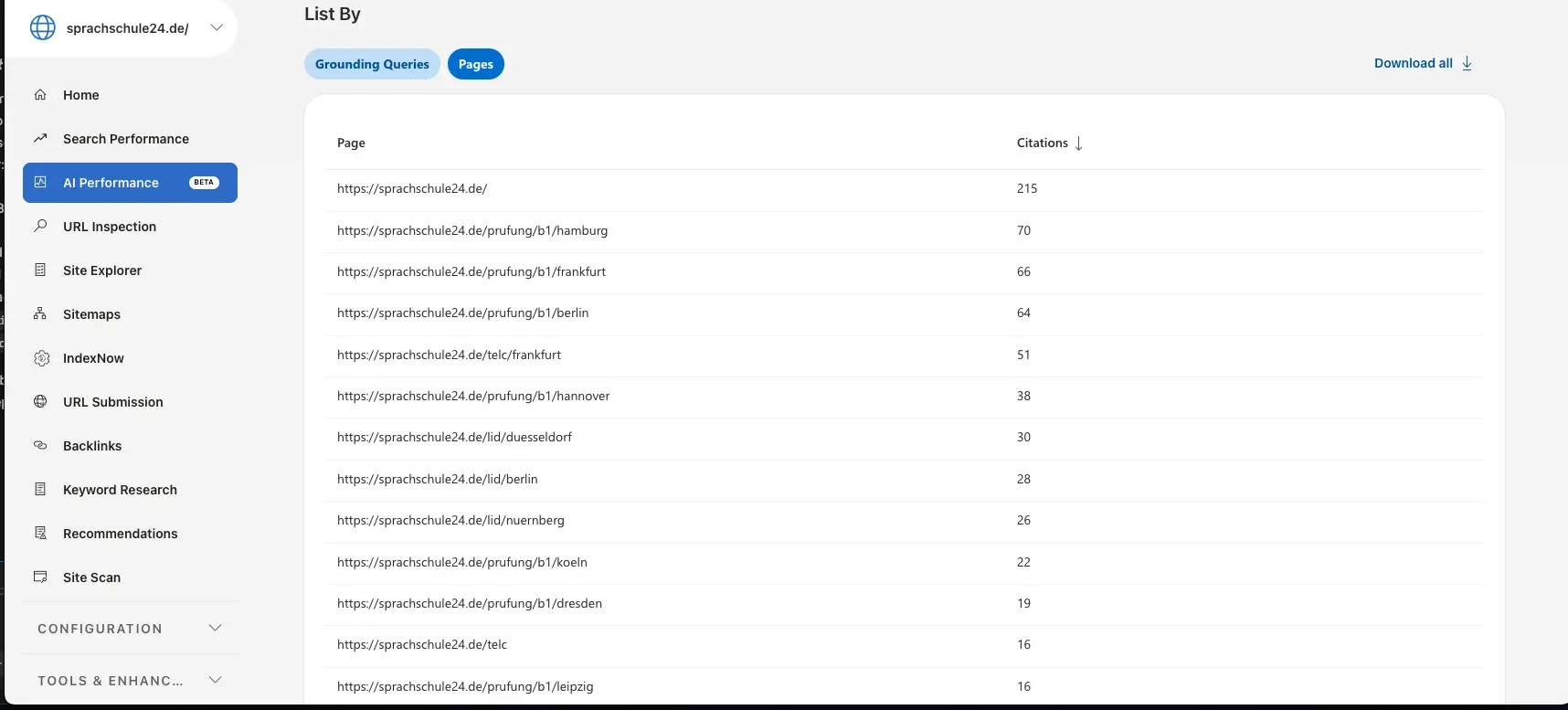
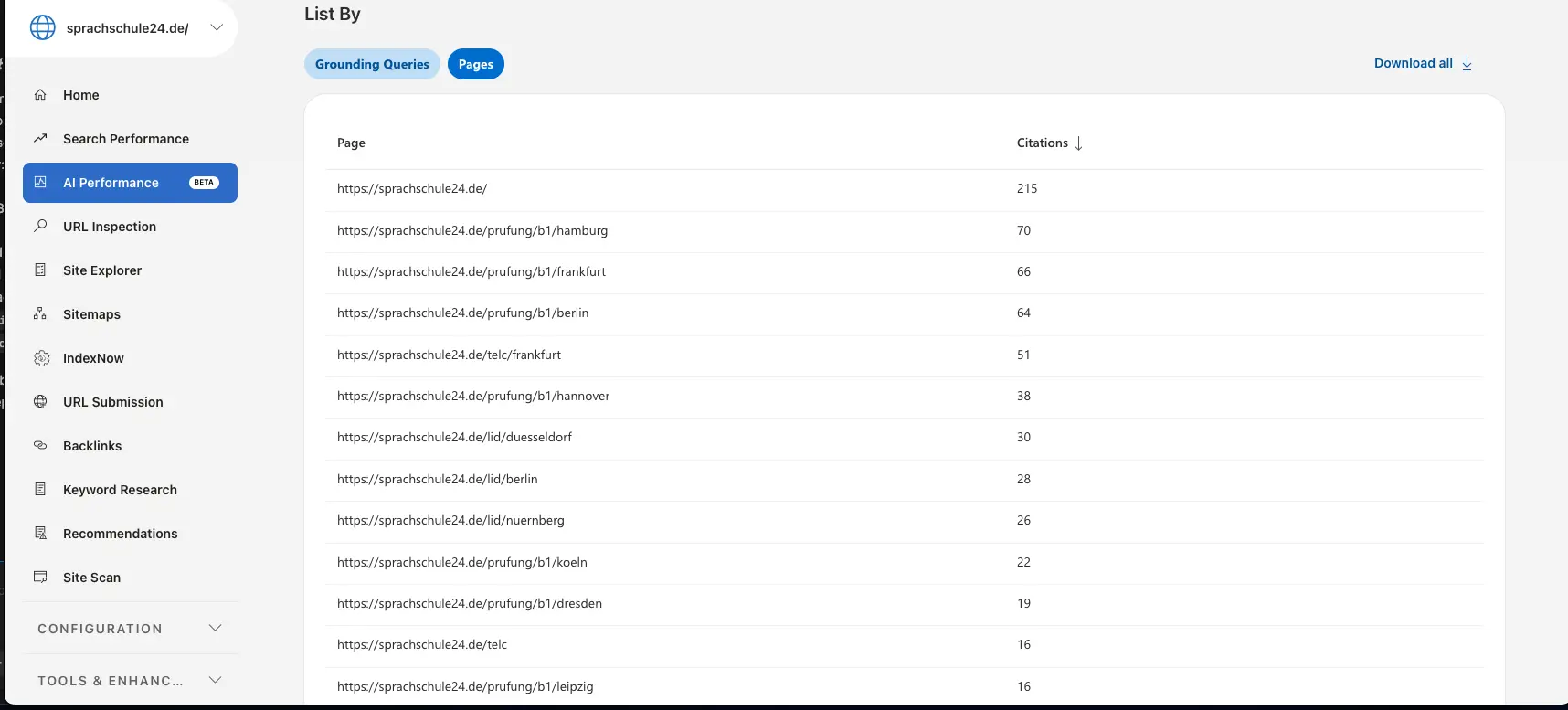
Instead of relying on theoretical advice, we build our strategies on real data from our own portfolio. Getting cited by AI engines like Microsoft Copilot requires structured, authoritative content. Our AI Performance data from Bing Webmaster Tools shows exactly what AI systems prefer. Across our projects, we've generated thousands of total citations. Here is how our approach translates to AI dominance:
- Content Dominance (Savion.de): For our client Savion.de, their top blog post ("/blog/was-ist-ziegenmilchseife") generated 353 AI citations. Other informational pages like "/blog/rueckfettende-seifen" and "/blog/aloe-vera-fuer-die-haare" followed closely with 263 and 206 citations respectively.
- Local Intent Capture (Sprachschule24.de): Sprachschule24.de successfully captured local AI search intents, generating top citations for highly specific local pages like "/pruefung/b1/hamburg" (70 citations) and "/pruefung/b1/frankfurt" (66 citations). For an HVAC company, creating structured, informative pages for specific local services is your ticket to dominating AI search results.
5. FAQs: Top Questions About Local GEO & SEO
- How long does it take for SEO/GEO to show results?
- Realistically: You will see initial effects within 6–12 weeks (due to technical fixes and conversion rate improvements). Stable, compounding ranking and lead generation effects typically materialize after 3–6 months, depending on market competition and the speed of implementation.
- What is the difference between Google Business Profile (GBP) and GEO?
- GBP handles your local visibility in the Map Pack (Google Maps, local reviews, routing). GEO ensures visibility inside AI-generated answers (e.g., ChatGPT recommending "The most reliable HVAC contractors in [City]") by utilizing structured, citable content and strong E-E-A-T signals.
- Why isn't my site ranking even though I included "all the keywords"?
- Because modern algorithms prioritize meaning and intent over exact keyword matching. Keyword stuffing is no longer a growth lever; it's a liability. What works: Highly specific service pages, direct answers, lightning-fast UX, and local proof.
- Why is call and lead tracking so critical?
- Because content optimization and GEO strategies only work when fed accurate data. Without clean tracking, you are optimizing for "traffic" instead of revenue. For local businesses, the only metrics that matter are qualified leads and close rates.
6. Results & ROI: The Real Impact of Optimization
We don't measure success in "visibility." We measure it in leads, calls, booked appointments, and revenue.
The KPIs we track for local HVAC projects:
- Leads (Forms, calls, calendar bookings).
- Conversion Rate per specific service page.
- CPL (Cost per Lead) – driven by organic search and AI traffic.
- Close Rate (Lead → Paid Job).
- ROI (Actual profit margin, not vanity metrics).
The ROI Logic (Simple, but brutally honest)
If an average HVAC installation/repair job yields $1,500 in revenue, and your close rate is 30%, then the expected value of a single lead is:
Lead Value = $1,500 × 0.30 = $450
If our SEO and GEO optimization systems drive your CPL down from $120 to $60, while simultaneously doubling your conversion rate, that isn't just "marketing." That is a massive margin multiplier.
7. Conclusion: Your Blueprint for Digital Market Dominance
Local markets are not won by publishing "more content." They are won through systematic relevance:
- SEO secures your organic rankings and Map Pack power.
- GEO ensures AI systems understand and cite you as the top local authority.
- Conversion Architecture turns that traffic into actual appointments.
- Data/Tracking ensures you control your ROI instead of hoping for it.
If your website is just a "digital brochure" today, AI systems will bypass it tomorrow. But if it is structured, fast, provably competent, and machine-readable, it becomes a high-yielding asset generating predictable leads—freeing you from the reliance on word-of-mouth.
8. Request an Audit: Your Next Step
If you are a local service provider (HVAC, Plumbing, Home Services) tired of invisible organic performance and ready for measurable leads and digital dominance, we start with a clear, no-nonsense diagnostic audit:
- ✔️ Tech Check: Core Web Vitals, Indexing, Schema, Site Architecture.
- ✔️ Local Check: GBP, NAP consistency, Review strategy, Location-Service mapping.
- ✔️ GEO Check: Citable formats, E-E-A-T signals, FAQ architecture, Entity clarity.
- ✔️ Conversion Check: CTAs, Funnels, Quizzes, Booking logic.
- ✔️ Tracking Check: GA4, Call Tracking, Lead Quality scoring.
Contact Us: www.ad-ninjas.net
Tim Noel Kadach (Partner, B.A.) – tim@ad-ninjas.net
Max Uhrmann (Partner, B.Sc.) – max@ad-ninjas.net
Optional: As a quick win, we can implement an HVAC Diagnostic Quiz Funnel (Issue → Urgency → Zip Code → Book Call) as an overlay on your current site. This is often the fastest way to instantly increase lead volume while the broader SEO momentum builds up.
Benötigen Sie Unterstützung?
Unsere GEO LeistungenHinweis gemäß EU AI Act: Dieser Artikel wurde mit Unterstützung von Künstlicher Intelligenz erstellt und vor Veröffentlichung von der Redaktion geprüft.

Tim Noel Kadach
Partner & Experte für Digital Business Architecture, Uhrmann & Kadach GbR
Verfasst bei Ad Ninja — Marketing Agentur für KMUs in Nürnberg. Spezialisiert auf Google Ads, SEO und datengetriebene Wachstumsstrategien.
Weitere Artikel zum Thema
Website-Optimierung: Vermeiden Sie den „Set and Forget“-Fehler
Viele Relaunches sehen gut aus – liefern aber nach wenigen Monaten weniger Leads. Erfahren Sie, warum „Set and Forget“ Ihre Website entwertet und wie kontinuierliche Daten-Analyse, Core Web Vitals, SEO & GEO messbar mehr Anfragen bringen.
7. Juli 2026GEOGEO 2026: Revolutioniert B2B-Suche mit KI
Generative Engine Optimization (GEO) für KMU im B2B: So werden Sie 2026 in ChatGPT, Perplexity & Co. gefunden – mit Technik, E-E-A-T, Schema, Core Web Vitals und Conversion-Systemen wie Quiz-Funnels.
29. Juni 2026GEOB2B-Triggers: Webseiten, die Entscheider klicken
Conversion Design Psychologie im B2B: Lernen Sie die 3 kognitiven Trigger (Autorität, Klarheit, Prozess-Transparenz), die Entscheider zum Klicken bringen – inkl. Ad Ninja Praxis, Case Studies, Tech-SEO & GEO.
29. Juni 2026Haben Sie Fragen?
Hinterlassen Sie E-Mail und Telefonnummer – wir rufen Sie kurzfristig zurück.